
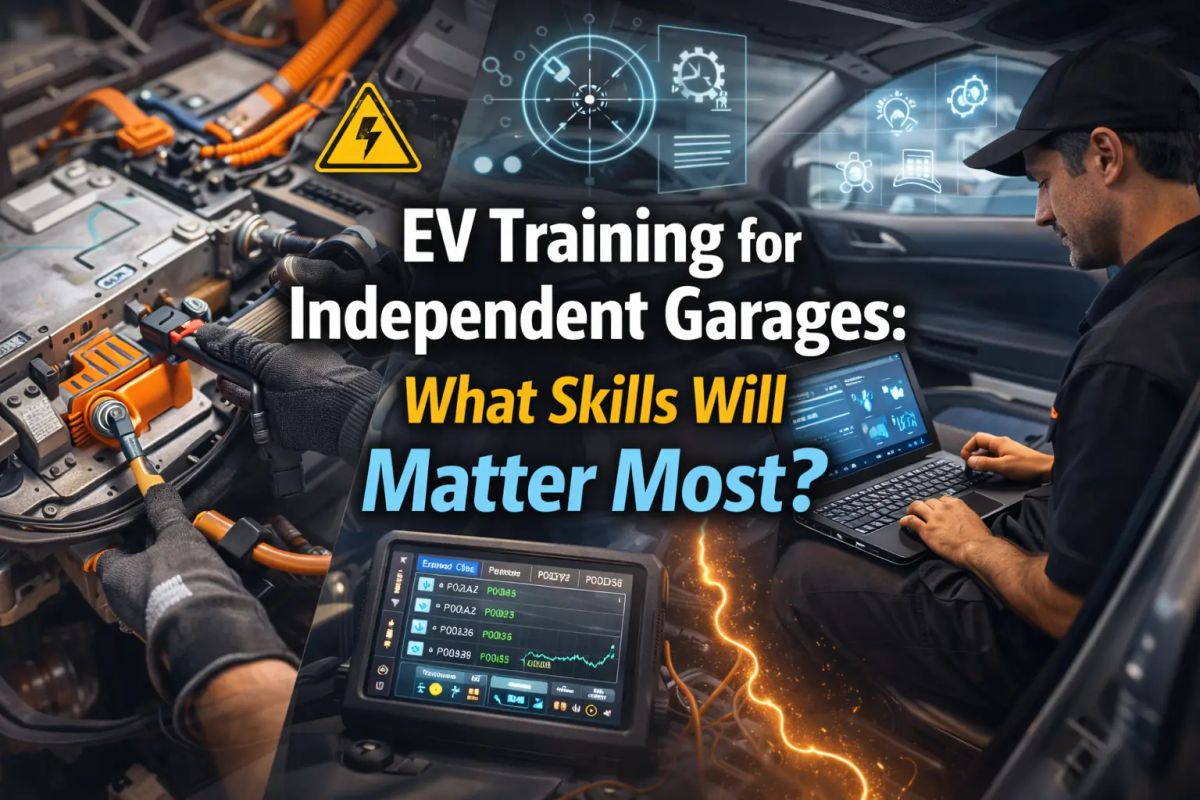
EV Training for Independent Garages: Key Skills
EV training does not require independent garages to abandon petrol and diesel work overnight. The most realistic and effective approach is incremental upskilling, focused on safety, diagnostics and electrical competence.
This guide outlines the core skills that will matter most, the training pathways available, and how garages can layer EV capability on top of existing expertise.
Quick Summary
- Start with high-voltage safety before spending money on advanced equipment.
- Add EV diagnostics in stages so the team can keep earning from ICE work.
- Focus on training that fits the jobs your garage is most likely to see first.
Step 1: High-Voltage Safety Training
High-voltage safety training is the essential starting point. Technicians must be able to identify EV systems, isolate high-voltage circuits safely and work confidently around live components.
This is about protecting staff as much as vehicles.
Training providers include:
- IMI - Institute of the Motor Industry
- City & Guilds EV qualifications
- Local colleges and training centres
Typical costs: £300-£1,500 depending on level. Some local authorities and trade bodies offer subsidised places.
Step 2: Diagnostics and Fault-Finding
Once safety foundations are in place, diagnostics become the most valuable skillset. EVs rely heavily on control units and software, meaning fault-finding increasingly involves interpreting data, understanding system logic and tracing electrical issues rather than replacing mechanical components.
Battery management systems, onboard chargers, inverters and power electronics are all areas where independent garages can add real value with the right training.
Not every garage needs to rebuild battery packs, but being able to diagnose faults accurately will be critical.
Step 3: ADAS Calibration and Software Updates
ADAS calibration, software updates and electrical troubleshooting are also becoming core skills as vehicles become more connected and sensor-driven.
These capabilities are relevant to both EVs and modern ICE vehicles, making them a smart investment regardless of powertrain mix.
Investment in diagnostic tools for these areas pays off across the entire vehicle fleet, not just EVs.
What Training Costs and How to Fund It
Training costs can seem daunting for small garages with tight margins, but support is available:
Funding sources to explore:
Running a UK garage?
AutoChain puts bookings, service records, and customer communications in one place. No paperwork, no missed follow-ups.
Get your first month free →- Apprenticeship Levy (for eligible businesses)
- Local Enterprise Partnerships (LEPs)
- Independent Garage Association member schemes
- Skills bootcamp programmes (government-backed)
Reducing admin with garage management software can free time and cash flow to put toward training and certification.
Further information: Gov.uk - Skills Bootcamps
How to Implement EV Training Without Disruption
The key to successful upskilling is gradual implementation:
- Start with one technician – Don't send the whole team at once
- Layer skills onto ICE work – EV capability complements rather than replaces
- Partner with specialists – Subcontract complex work while building skills
- Market your capability – Let customers know you're EV-ready
- Invest in one diagnostic tool at a time – Spread costs over multiple years
The Bottom Line
With targeted training and proper support, independent garages can layer EV competence on top of existing expertise, protecting current revenue while preparing for future demand.
The garages that thrive will be those that:
- ✅ Start training early, even if EV volume is low today
- ✅ Focus on safety first, diagnostics second
- ✅ Invest incrementally rather than all at once
- ✅ Market their EV capability to build customer confidence
Related reading: Will Independent Garages Survive the EV Transition?
Why Choose AutoChain
AutoChain's network includes independent garages with EV training and high-voltage certification. Whether you need EV diagnostics, battery health checks or traditional ICE repairs, we connect you with trusted local experts.
Find an EV-ready garage near you today.
Related Articles:
- Will Independent Garages Survive the EV Transition?
- What Maintenance and Repairs Do Electric Cars Need?
- Will EV Repairs Be Controlled by Dealers?
- What Will Independent Garages Look Like in 2040?
Training Resources:
- IMI - Electric Vehicle Training
- Independent Garage Association - Training Support
- City & Guilds EV Qualifications
Frequently Asked Questions
What EV qualifications do garage technicians need in the UK?
The Institute of the Motor Industry (IMI) offers the most widely recognised EV qualifications for UK automotive technicians. Level 2 covers awareness of electric and hybrid vehicle technology — suitable for service advisors and non-technical staff. Level 3 is the practical qualification for technicians working on EV systems, covering high-voltage safety procedures, battery management, and routine EV maintenance. Level 4 is advanced diagnostics. The IMI TechSafe register lists technicians who hold current EV qualifications, allowing consumers to verify their garage's credentials before booking EV work. City & Guilds and BTEC also offer EV qualifications that are widely accepted in the industry.
How much does EV training cost for a garage?
Costs vary depending on the level and provider. An IMI Level 3 EV course typically costs between £500 and £1,500 per technician, depending on the provider and whether assessment is included. Many training providers offer employer funding through the Institute for Apprenticeships and Technical Education or through manufacturer-supported schemes. The OZEV (Office for Zero Emission Vehicles) has supported various training initiatives for independent garages. Garages in England may also be able to access funding through the Advanced Learner Loans scheme for eligible employees. The total investment per technician — including course fees, time off the tools, and assessment — is typically recovered within six to twelve months of taking on EV work regularly.
How quickly is EV demand growing for independent garages?
UK new car registrations show that battery electric vehicles (BEVs) accounted for over 22% of new car sales in 2024, with the share continuing to rise under the Zero Emission Vehicle mandate requiring manufacturers to meet escalating EV targets through 2035. As these vehicles age out of manufacturer warranty periods (typically three to seven years), they will increasingly need independent garage servicing. Industry analysts estimate that by 2028, there will be sufficient EVs on UK roads for the majority of independent garages to see regular EV work. Garages that invest in training now are positioning themselves for significant demand growth over the next three to five years.

Ready to run a smarter garage?
Get your first month free today.
No card required. Get set up in under 10 minutes.