
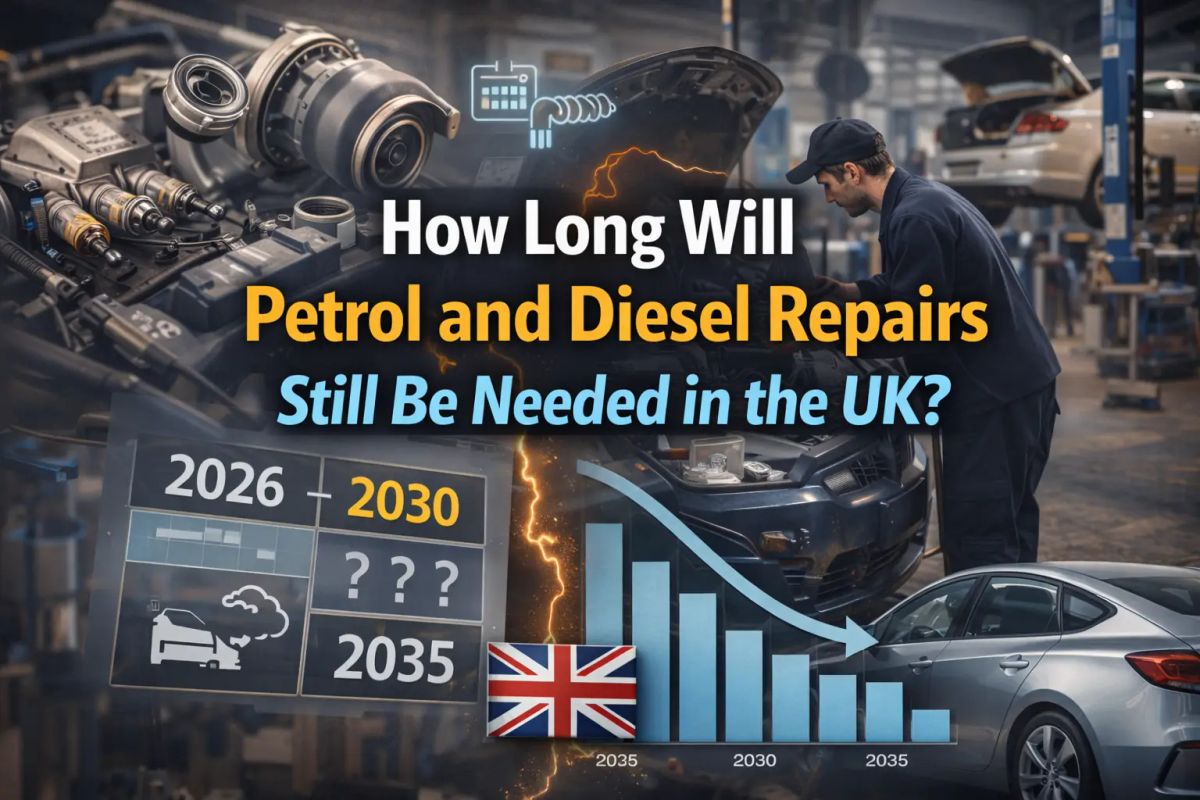
How Long Will Petrol & Diesel Repairs Be Needed?
Petrol and diesel vehicles will remain a significant part of the UK car parc for many years. Despite declining new registrations, the average age of vehicles continues to rise, and millions of ICE cars will still require maintenance well into the 2030s.
This means exhausts, engine servicing, fuel system repairs, turbochargers and emissions-related faults are not disappearing any time soon. For many garages, this work will remain the backbone of day-to-day operations in the short to medium term. Garage management software can help you run and plan that workload efficiently as you balance ICE and future EV work.
The Current State of the UK Vehicle Parc
According to the Society of Motor Manufacturers and Traders, there are approximately 33 million vehicles on UK roads. The vast majority are petrol and diesel.
Key insight: Even though EV registrations are growing, the installed base of ICE vehicles is enormous and slow to turn over.
New Registrations vs. Existing Vehicles
While new petrol and diesel car sales are declining, this does not immediately translate into falling repair demand. The average age of UK vehicles is now over 9 years and rising, meaning older ICE cars are staying on the road longer.
This creates a lag effect: garages will continue servicing ICE vehicles for many years even as new sales shift to electric.
What ICE Work Will Remain in Demand?
Traditional engine-focused repairs will continue to generate reliable income through the 2020s and into the 2030s. The most common work includes:
Important: These timelines assume government policy remains on track. Delays to EV mandates would extend ICE repair demand further.
The Gradual Decline Timeline
The shift away from ICE repairs will be gradual, not sudden. Here's a realistic timeline:
2026-2030: ICE Work Remains Strong
- New ICE sales still significant (though declining)
- Large ageing fleet requires regular servicing
- Exhausts, brakes, tyres, servicing all high-demand
- Garage impact: Business as usual with early EV adopters
2030-2035: Transition Accelerates
- Government targets 80%+ zero-emission new sales by 2030
- ICE fleet begins to shrink noticeably
- Engine work still common but volumes declining
- Garage impact: EV skills become essential to maintain revenue
2035-2040: ICE Becomes Niche
- Most new vehicles are EV or zero-emission
- ICE fleet increasingly older, lower-value vehicles
- Specialist ICE garages may emerge (like classic car restoration)
- Garage impact: EV work dominates, ICE work is supplementary
Regional Variations
Running a UK garage?
Independent UK garages use AutoChain to win more repeat work, cut admin, and compete with national chains.
Get your first month free →The decline of ICE repairs will not be uniform across the UK:
- Urban areas (London, Manchester, Birmingham) will see faster EV adoption
- Rural areas may retain ICE vehicles longer due to charging infrastructure gaps
- Commercial fleets (vans, lorries) will transition more slowly than private cars
- Lower-income areas will have older ICE vehicles for longer
This means some garages can rely on ICE work longer than others, depending on location and customer base.
What Garage Owners Should Do Now
For independent garages, ICE repairs represent today's reliable income stream, but not tomorrow's growth market.
Strategic actions:
- Maximise ICE income now – Remain excellent at traditional repairs
- Begin EV training gradually – At least one technician should gain Level 2 certification
- Monitor your local market – Track EV adoption in your area
- Diversify income streams – Tyres, MOTs, bodywork are more future-proof
- Plan a 10-year transition – Layer EV capability onto existing ICE expertise
Related article: Will Independent Garages Survive the EV Transition?
Treating ICE work as a cash flow foundation while building EV capability alongside it allows businesses to manage the transition steadily rather than being forced into sudden change.
The garages that plan early will have more control over how that transition unfolds.
The Bottom Line
Petrol and diesel repairs are not vanishing overnight. There will be strong, reliable demand for ICE servicing well into the 2030s, particularly for older vehicles and diesel fleets.
However, relying exclusively on ICE work carries long-term risk. The pool of vehicles needing traditional engine repairs will steadily shrink as EVs become mainstream.
Forward-thinking garages are already treating ICE work as today's revenue stream, while preparing EV capability as tomorrow's core business.
Related reading: What Will Independent Garages Look Like in 2040?
Why Choose AutoChain
Whether you drive a petrol, diesel, hybrid or electric vehicle, AutoChain connects you with trusted independent garages that can service and maintain your car to the highest standards.
Our network covers:
- 🔧 All petrol and diesel servicing and repairs
- ⚡ EV-trained technicians for electric vehicles
- 🚐 Commercial vehicle and van repairs
- 📱 Digital service history for all fuel types
Find a garage near you or learn more about our services.
Related Articles:
- Will Independent Garages Survive the EV Transition?
- What Maintenance and Repairs Do Electric Cars Need?
- EV Training for Independent Garages
- What Will Independent Garages Look Like in 2040?
Data Sources:
- SMMT - UK Vehicle Registration Data
- Gov.uk - Zero Emission Vehicle Mandate
- DfT - Vehicle Licensing Statistics
Frequently Asked Questions
When will petrol and diesel cars be banned in the UK?
The UK government has confirmed that the sale of new petrol and diesel cars will end by 2035. The Zero Emission Vehicle (ZEV) mandate requires that a rising percentage of new cars sold by each manufacturer must be zero-emission each year, reaching 100% by 2035. Importantly, this ban applies only to the sale of new ICE vehicles — existing petrol and diesel cars can continue to be driven and will still need servicing and repairs for decades after 2035. With the average UK car staying on the road for 14 years, petrol and diesel vehicles bought before 2035 will still be in use well into the 2040s and beyond.
Will petrol and diesel parts become harder to source in future?
Parts availability for ICE vehicles will remain strong for many years due to the sheer volume of vehicles on the road. The global automotive aftermarket supplies parts for vehicles many decades old, and market forces ensure that parts continue to be manufactured as long as there is demand. For common platforms — such as popular Ford, Volkswagen, and Toyota models — parts availability is unlikely to become a practical problem for owners within the next 20 years. For less common or older vehicles, parts sourcing may become more challenging over time, but this is a gradual process rather than a sudden cutoff.
How should independent garages prepare for the EV transition?
Independent garages can prepare for the EV transition by investing in technician training now, ahead of the demand peak. IMI Level 3 EV qualifications, combined with investment in basic EV diagnostic and charging equipment, position a garage to handle routine EV maintenance. Garages should also consider their premises — EV charging points for customer vehicles and a dedicated safe area for high-voltage work are valuable investments. Beyond technical preparation, building a reputation now for quality, transparency, and digital communication (through platforms like AutoChain) helps garages attract and retain the next generation of EV-owning customers who expect a modern, digital service experience.

Ready to run a smarter garage?
Get your first month free today.
No card required. Get set up in under 10 minutes.