
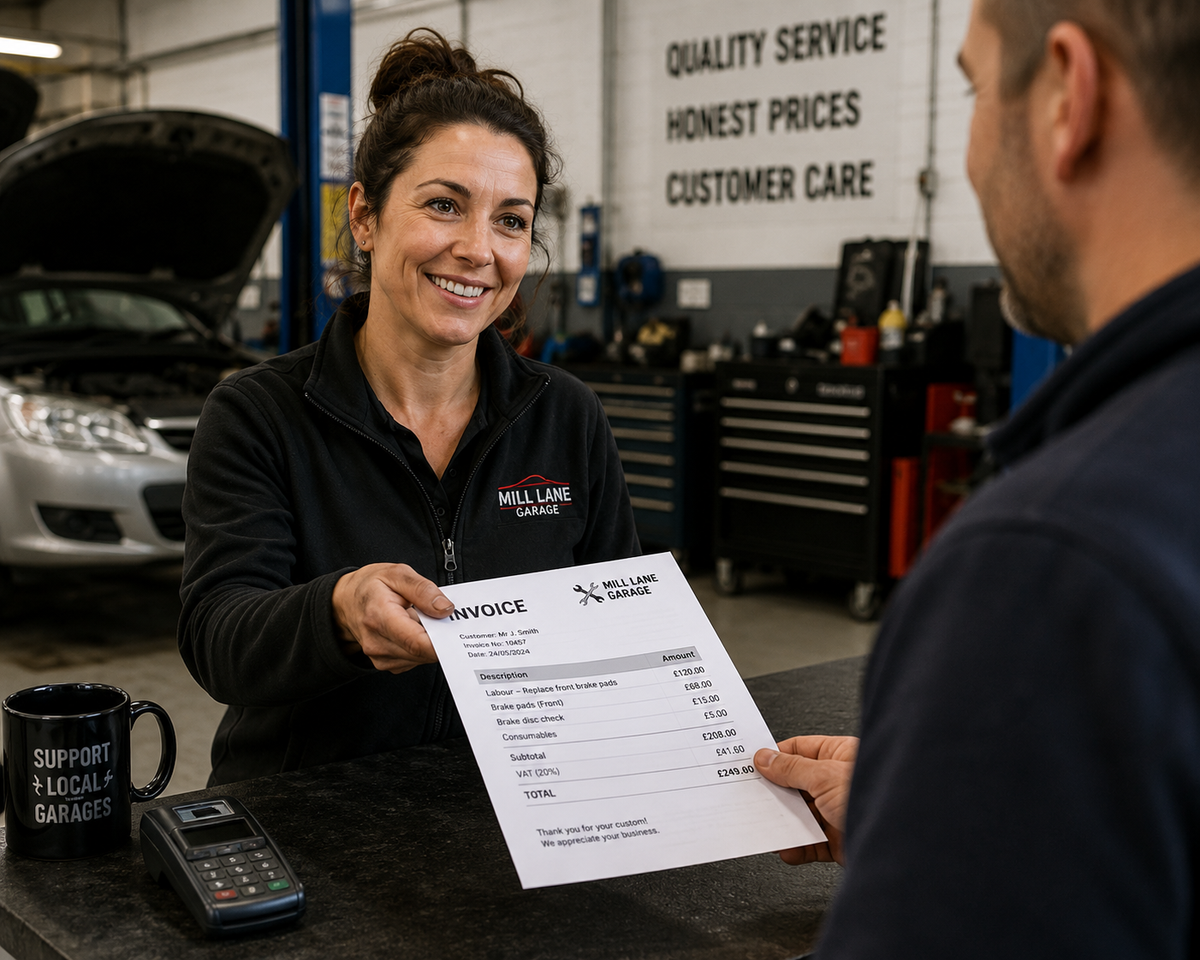
If you run an independent garage in the UK, invoicing is likely one of the most frustrating parts of your day. Writing tickets by hand, copying job card details into a spreadsheet, or wrestling with generic accounting software that has no concept of a labour hour or a parts margin — these workflows cost real time and real money.
The problem is not discipline or effort. The problem is using the wrong tools. Most billing software is designed for accountants, not mechanics. That gap between the workshop floor and the invoice ledger creates errors, delays, and lost revenue.
This guide walks through what to look for in dedicated garage invoice software, what the law requires, and how purpose built workshop management platforms like AutoChain are closing the gap.
Why generic accounting tools fail independent workshops
Generic billing applications lack the specific industry architecture required to track workshop labour rates, parts markup percentages, and vehicle registration numbers simultaneously. This disconnect creates double entry administrative friction for front desk teams and increases the risk of undercharging or missing billable hours entirely.
When a technician completes a service, the details live on a job card vehicle registration, labour time, parts used, advisory notes. Generic tools like basic Xero or Sage have no native understanding of that job card structure. Someone at the front desk must manually key every line item into a separate billing tool.
This creates two serious problems. First, it is time consuming. Every manual transfer is a task that pulls a team member away from customer service. Second, it introduces error. A wrong part number, an incorrect labour rate, or a forgotten advisory item means the invoice goes out wrong. The customer may dispute it, or worse, the garage absorbs the loss without noticing.
Workshops also deal with fluctuating parts prices from different factors. Generic accounting tools offer no mechanism for tracking the bought price versus the sold price on a per job basis. That margin visibility is not a luxury it is the difference between a profitable job and one that breaks even.
Key features to look for in garage invoice software
Effective garage invoice software must integrate booking diary management, parts procurement with margin tracking, and vehicle health check records into a single connected workflow. Tools that lack these automotive specific features force workshops into manual data transfer, increasing error rates and reducing billable recovery rates on both labour and parts.
The best automotive invoicing tools are built around the core workflow of a workshop from booking through diagnosis, parts ordering, labour tracking, and final billing. Each step must connect to the next without additional manual data entry.
Live connection to a workshop scheduling diary
A live connection between the booking diary and the invoicing module ensures that no job leaves the workshop without a corresponding invoice. Workshop billing systems with diary integration flag unbilled jobs automatically, closing the gap between completed labour and collected revenue.
When a vehicle booking is confirmed in the diary, that appointment should become the seed of the invoice. As the job progresses, time entries, technician notes, and parts added during the service attach directly to that record. At the point of handover, the invoice is effectively complete.
This is especially important for multi bay workshops where different technicians may work on the same vehicle. A shared, live diary means the invoice reflects the full picture, not just what one person remembered to enter.
Independent garages that rely on separate diary tools and separate billing tools are doubling their administrative workload every time a job is completed. The connection is not optional it is foundational.
Integrated parts procurement and margin management
Integrated parts procurement within an invoicing tool for mechanics allows businesses to record bought cost and retail price simultaneously against each job line. This produces accurate parts margin reporting per invoice and prevents the chronic underpricing that results from applying a flat markup without reference to the actual factor price.
Parts pricing is one of the most complex areas of garage profitability. Prices from factors change regularly. Different factors offer different trade discounts. And under time pressure, it is easy to apply a rough markup rather than the correct one.
An integrated parts module solves this by linking the parts order directly to the invoice line. The bought price is recorded at the point of ordering. The system applies the correct retail price based on configured margin rules. The result is accurate invoicing every time, with full visibility into parts profitability across all jobs.
For garages ordering from multiple suppliers, this integration also reduces the risk of using the wrong part number on the invoice, which causes delays, disputes, and returns.
Native vehicle health check linking
Native vehicle health check (VHC) integration within garage invoice software allows advisory recommendations captured during a service to convert directly into booked work and then into an invoice at a later date. This prevents advisory revenue from falling through the cracks between one visit and the next.
A VHC is only as valuable as the follow through. A technician may flag four advisory items during a service. If those items live in a separate PDF or on paper, the likelihood of conversion into future bookings depends entirely on manual follow up.
With native VHC linking inside the workshop billing system, each advisory item can be saved against the vehicle record. When the customer books back in, those items populate the new job card and feed directly into the next invoice. The full advisory revenue potential of each vehicle visit is captured, not lost.
This feature is also an important part of building customer trust. A professional, traceable health check record shows the customer that the garage is thorough and transparent.
The legal landscape of UK digital invoicing
Making Tax Digital legislation requires most VAT registered UK businesses to maintain digital records and submit VAT returns through approved software. Purpose built workshop billing systems that generate compliant digital transaction records automatically reduce administrative overhead and protect garages against HMRC compliance risk.
The UK government's Making Tax Digital programme mandates digital record keeping and digital submission of VAT returns for most VAT registered businesses. Garage owners operating below the VAT threshold should also be aware that MTD is expected to extend to income tax self assessment in coming years.
Using dedicated garage invoice software that is built with digital compliance in mind removes the administrative burden of satisfying these requirements. Rather than exporting spreadsheets or manually preparing submissions, a compliant workshop billing system maintains the required digital records as a natural byproduct of normal day to day use. For full and up to date legal requirements, garage owners should consult the official GOV.UK Making Tax Digital guidelines to ensure their current workflows meet HMRC expectations.
Choosing software that integrates with compliant accounting outputs also protects the business in the event of an HMRC inquiry, as all transaction records are stored digitally and are retrievable quickly.
Streamlining your workshop with AutoChain
AutoChain is purpose built garage management software combining technician scheduling, automated customer alerts, parts procurement, and direct invoicing in a single cloud based platform. Designed specifically for independent UK workshops, AutoChain eliminates the manual data transfer between job cards and billing systems that costs independent garages time and revenue.
Rather than bolting invoicing onto a generic accounting tool, AutoChain natively connects every stage of the workshop workflow. From the moment a vehicle is booked in, the system begins building the invoice. Labour time is tracked against the job. Parts are ordered and their costs recorded. VHC items are logged and linked to the vehicle history. Automated customer alerts keep owners informed throughout the process. When the job is complete, the invoice is ready with no additional data entry required.
AutoChain also handles the margin complexity that trips up generic tools. Parts bought from any factor are recorded at cost. The platform applies the correct retail price according to the garage's own margin rules. The result is accurate, professional invoicing on every job, with full visibility into what each vehicle visit actually contributed to the bottom line.
For independent garages looking to move beyond the patchwork of job cards, spreadsheets, and disconnected billing tools, AutoChain offers a single, coherent system that handles the full workshop workflow. Explore the full capability set on the AutoChain garage management software platform.
Choosing the right invoicing software is not just about saving time at the end of the day. It is about building a workshop that is accurate, compliant, and profitable on every single job.

Ready to run a smarter garage?
Get your first month free today.
No card required. Get set up in under 10 minutes.