Customer Intelligence forSmarter Garage Growth
See who is loyal, who is drifting away, and which missed jobs are hurting revenue. The dashboard is built for busy UK workshops, not data teams.
At a glance
- Spot customers who have stopped booking or stopped replying.
- See unfinished quotes and declined work that may still be recoverable.
- Prioritise follow-up based on value, loyalty, and risk.
What Customer Intelligence Actually Gives a Garage
Most workshops have customer data, but very few can turn it into clear action. AutoChain helps you see loyalty, risk, and missed revenue without needing a separate analytics team or another complex tool.
See which customers are engaged, drifting away, or likely to rebook based on visit frequency, spend, and response patterns.
Spot missed follow-ups, unanswered messages, and weak handovers before they turn into lost trust or negative reviews.
Identify dormant customers, overdue work, and unresolved advisories that represent missed labour and parts revenue.
Track satisfaction trends and see where service quality, communication, or expectation setting needs attention.
Watch customer emails in real time with clear statuses for queued, pending, sent, engaged, and failed messages.
Dashboard Focus
Actionable Signals, Not Noise
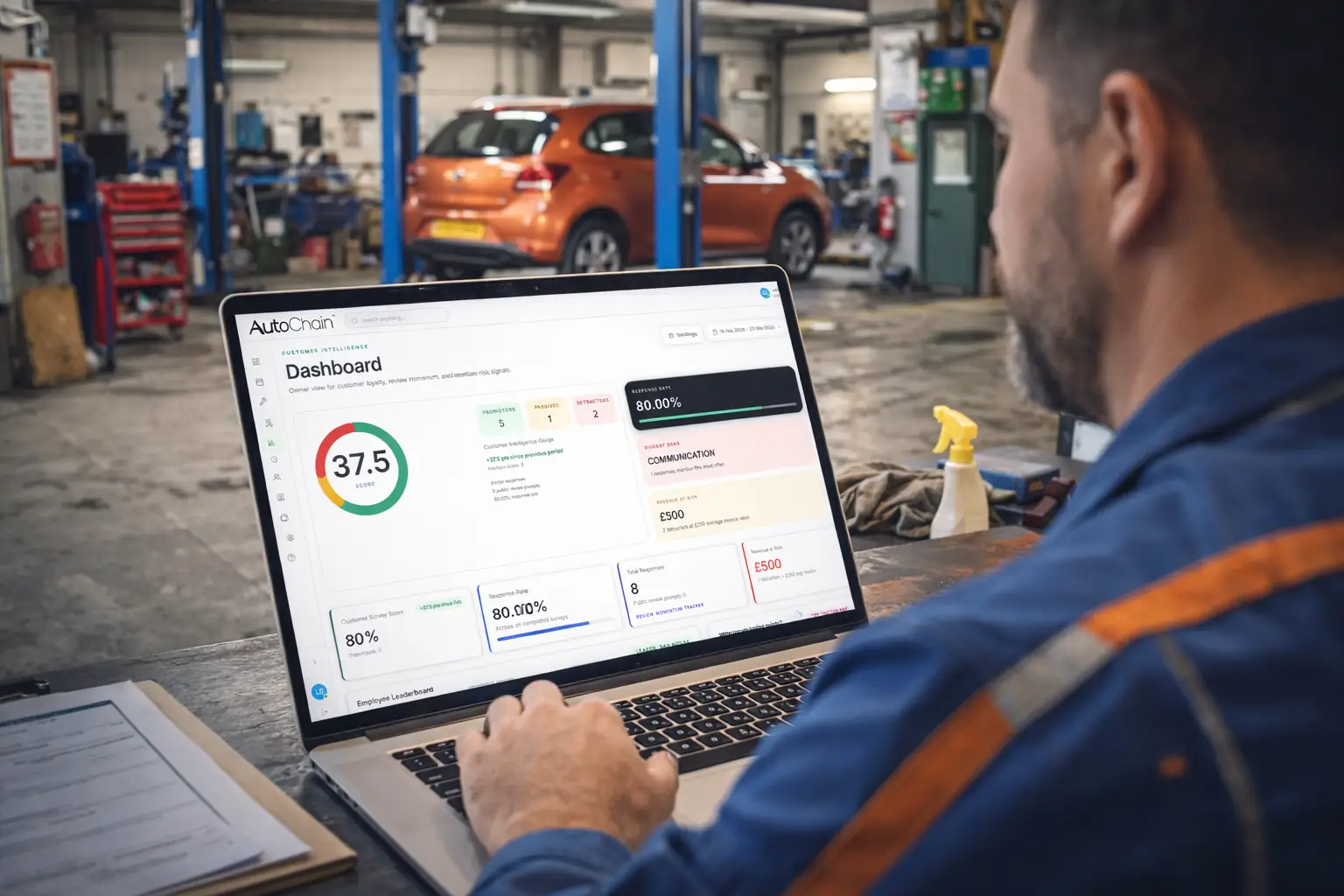
Customer Intelligence is built for busy service advisors and garage owners. It highlights what needs attention now instead of burying you in reports. You can quickly see strong loyalty signals, at-risk relationships, weak communication patterns, real-time message history, and unresolved jobs that should be brought back into the diary.
A single health score makes it easier to prioritise follow-up work.
Risk tags flag customers who need action before they quietly disappear.
Clear communication history reduces guesswork and protects service quality.
Real-time message history shows queued, pending, sent, engaged, and failed emails at a glance.
Strong loyalty
5
Customers likely to rebook or recommend your garage.
Needs attention
1
Needs a better follow-up journey to stay engaged.
Detected issues
- Two overdue advisory callbacks with no follow-up this week.
- One recent poor communication signal from a customer touchpoint.
- Estimated revenue at risk from unbooked work: £500.
Message history
Queued
12
Pending
4
Sent
28
Engaged
9
Failed
1
How Customer Intelligence Works
AutoChain analyses customer behaviour and uses that insight to time follow-up emails for stronger engagement, more positive reviews, and better long-term loyalty.
AutoChain brings together service history, reminders, outcomes, and customer responses so you can build a clearer picture of what each customer values and how they engage with your garage.
Our algorithm calculates when each follow-up email is most likely to be opened and acted on, helping you maximise engagement instead of sending generic reminders at the wrong moment.
Better-timed communication helps attract more positive reviews, strengthens loyalty, and gives you a deeper understanding of your customer base so you can improve retention over time.
Ideal for Garages That Want More Than Basic CRM
This feature is designed for independent workshops that already have customer data but need clarity on what to do with it. Instead of adding another inbox or spreadsheet, AutoChain helps your team focus on the next best action for retention, satisfaction, and profitable repeat work.
- Recover customers who have gone quiet after a quote or advisory
- See which regulars are due to churn before they disappear to another garage
- Understand whether review issues come from communication, delays, or pricing
- Prioritise callbacks that are most likely to recover revenue
- Give service advisors a clearer picture before speaking to customers
- Build a more proactive aftercare process without extra admin
- See queued, pending, sent, engaged, and failed emails from one live message history view
Why garages use it
Built for workshop reality
Service advisors get context fast
Before calling a customer, your team can see history, risk, and likely next steps.
Owners see revenue leakage clearly
Missed callbacks, overdue advisories, and quiet customers become visible and measurable.
Customer care becomes more proactive
You stop waiting for complaints or lost business to tell you something went wrong.
Frequently Asked Questions
What is customer intelligence for garages?
Customer intelligence surfaces loyalty risks, review trends, communication gaps, and missed revenue opportunities from your existing workshop data — so you know which customers need attention and what to do, without manually analysing spreadsheets.
Why do garages need customer intelligence?
Garages lose revenue silently through customers who drift away, unanswered advisories, or missed MOT reminders. Customer intelligence makes these risks visible before they become lost income.
What signals does AutoChain track?
Five key signals: Loyalty Score (engagement and visit frequency), Communication Gaps (missed follow-ups), Revenue At Risk (dormant customers and overdue advisories), Review Monitoring (satisfaction trends), and Booking Patterns (predicting next visit).
Is it included in AutoChain, or an add-on?
Customer Intelligence is included in the core AutoChain plan at £69.99/month + VAT — no additional charge. It sits alongside job management, invoicing, and digital service history.
How is it different from a basic CRM?
A CRM stores contacts. AutoChain's Customer Intelligence automatically analyses your service and communication patterns to generate actionable signals — no manual tagging or data entry required. Built specifically for independent garages, not adapted from generic sales software.
More About Customer Intelligence for Garages
What is customer churn and why does it matter more for garages than other businesses?
Customer churn refers to the rate at which customers stop using your business. For garages, churn is particularly damaging because car service relationships are high-value and long-term — a loyal customer who visits annually for servicing, MOTs, and occasional repairs can be worth £500–£1,500 per year over many years. Losing that customer to a competitor or a franchised dealer represents a significant loss of lifetime value. Research consistently shows that acquiring a new customer costs five to seven times more than retaining an existing one. Customer Intelligence tools help garages identify at-risk customers before they leave, enabling proactive outreach rather than reactive loss management.
How does communication quality affect customer retention at garages?
Communication quality is one of the strongest predictors of customer retention in the automotive service sector. Customers who receive clear, timely updates during a service — including confirmation that work has started, notification of any additional issues found, and a clear collection time — are significantly more likely to return. Conversely, customers who feel they were not kept informed, who had to chase for updates, or who received unexpected additional charges without prior authorisation are the most likely to switch garages. AutoChain's Customer Intelligence module tracks communication touchpoints and flags customers who have experienced communication gaps, giving your team the opportunity to follow up with a proactive call or personalised message to rebuild confidence.
Can Customer Intelligence identify customers who are likely to buy a new car soon?
Yes. AutoChain's Customer Intelligence analyses vehicle age, mileage trends, service history patterns, and repair frequency to identify customers whose vehicles may be approaching the point at which replacement becomes more attractive than continued maintenance. When a vehicle reaches a certain age or begins requiring repeated expensive repairs, the customer is at higher risk of purchasing a new car — and taking their servicing business to a franchised dealer. By identifying these customers early, garages can have proactive conversations about the relative costs of maintaining versus replacing, position the garage as a trusted adviser, and potentially offer pre-purchase inspections on prospective replacement vehicles. This turns a potential churn event into a new customer engagement opportunity.
What is the difference between Customer Intelligence and a basic CRM for garages?
A basic CRM (Customer Relationship Management) system stores contact details and records past transactions — useful for looking up customer history but essentially passive. Customer Intelligence goes further by actively analysing patterns across your entire customer base to surface actionable insights: which customers are overdue for a visit, which have declined recommended work that they might now be ready to revisit, which have not responded to recent communications, and which have the highest predicted lifetime value. Where a CRM tells you what has happened, Customer Intelligence tells you what is likely to happen and what you should do about it. AutoChain combines both — a full contact and service history database alongside analytical tools that help you prioritise your outreach and retention activity.
How do I get started with AutoChain Customer Intelligence?
Customer Intelligence is included as part of AutoChain's garage management platform, available to all subscribing garages. Once you begin using AutoChain for job management and invoicing, the system begins building customer profiles automatically from your booking and service data. Over time — typically after 60–90 days of active use — patterns become visible in the Customer Intelligence dashboard. You do not need to manually import customer data or configure complex analytics settings; AutoChain does the analysis automatically. To get started, register your garage at autochain.co.uk/register or book a demo through our contact page to see a walkthrough of the Customer Intelligence features before committing.
Why Retention Signals Matter More Than Broad Customer Lists
Most garages already have customer data of some kind. The harder problem is knowing which customers need attention now and why. A long list of names, past invoices, and vehicle registrations does not automatically tell the workshop who is drifting away, who declined important work, or which quiet accounts represent meaningful future revenue. Customer intelligence matters because it turns passive history into clearer prioritisation. It helps the team act before a dormant customer becomes a lost customer.
This is particularly valuable for independent workshops because repeat business is often built in small margins of timing and communication. A missed callback, an ignored advisory, or a lapse in reminders can weaken loyalty even when the technical work was good. When those risks become visible early, the garage has a chance to recover the relationship with a proactive call, a reminder, or a more informed conversation at the next visit. That is usually cheaper and more effective than trying to replace the customer through fresh acquisition.
Good customer intelligence therefore supports the practical economics of the workshop. It helps owners focus on the relationships most likely to affect future revenue and helps front-of-house teams communicate with better context. That is why it works best as an operational tool, not just a reporting feature.
See Customer Risk Before It Costs You Work
Customer Intelligence gives your garage a clearer view of loyalty, communication quality, and missed revenue opportunities so you can act earlier and retain more of the work you've already earned.
Why garage management software matters beyond the front desk
Garage management software creates value when it improves the full operating rhythm of the workshop, not just the booking diary. The strongest systems help garages keep jobs visible, records complete, invoices timely, and customer communication consistent. That is what turns software from an admin tool into something that genuinely changes how the business performs week to week.
Independent garages often lose margin through small operational gaps rather than obvious strategic mistakes. Missed reminders, weak follow-up, incomplete records, and time spent searching for information all compound over a month. A better management platform reduces those losses by linking workshop activity to customer records, future reminders, and clearer evidence of what was completed.
That is why features such as customer intelligence, digital service history, and dashboard visibility belong alongside job cards and invoicing. They help the garage protect existing customer value, understand where future work may be lost, and make the overall service experience easier for both staff and drivers to trust.
AutoChain is designed for workshops that want a simpler operating system with clearer records and better retention support. The point is not software for its own sake. It is a more organised, more transparent, and more commercially resilient way to run the garage.
When the platform captures more of the workshop context accurately, staff spend less time rebuilding the story of each vehicle and more time completing profitable work with clearer customer communication around it.